Tesla Is About to Build a Second Factory Hall in Germany – and It’s Still the Old One That Sleeps You

Tesla has confirmed to Brandenburg’s public broadcaster that it is preparing a permit application for a second production hall at its Grünheide factory outside Berlin – a building around two and a half times the size of the one that builds the Model Y today. If it goes ahead, the plant would eventually be able to build a million cars a year.
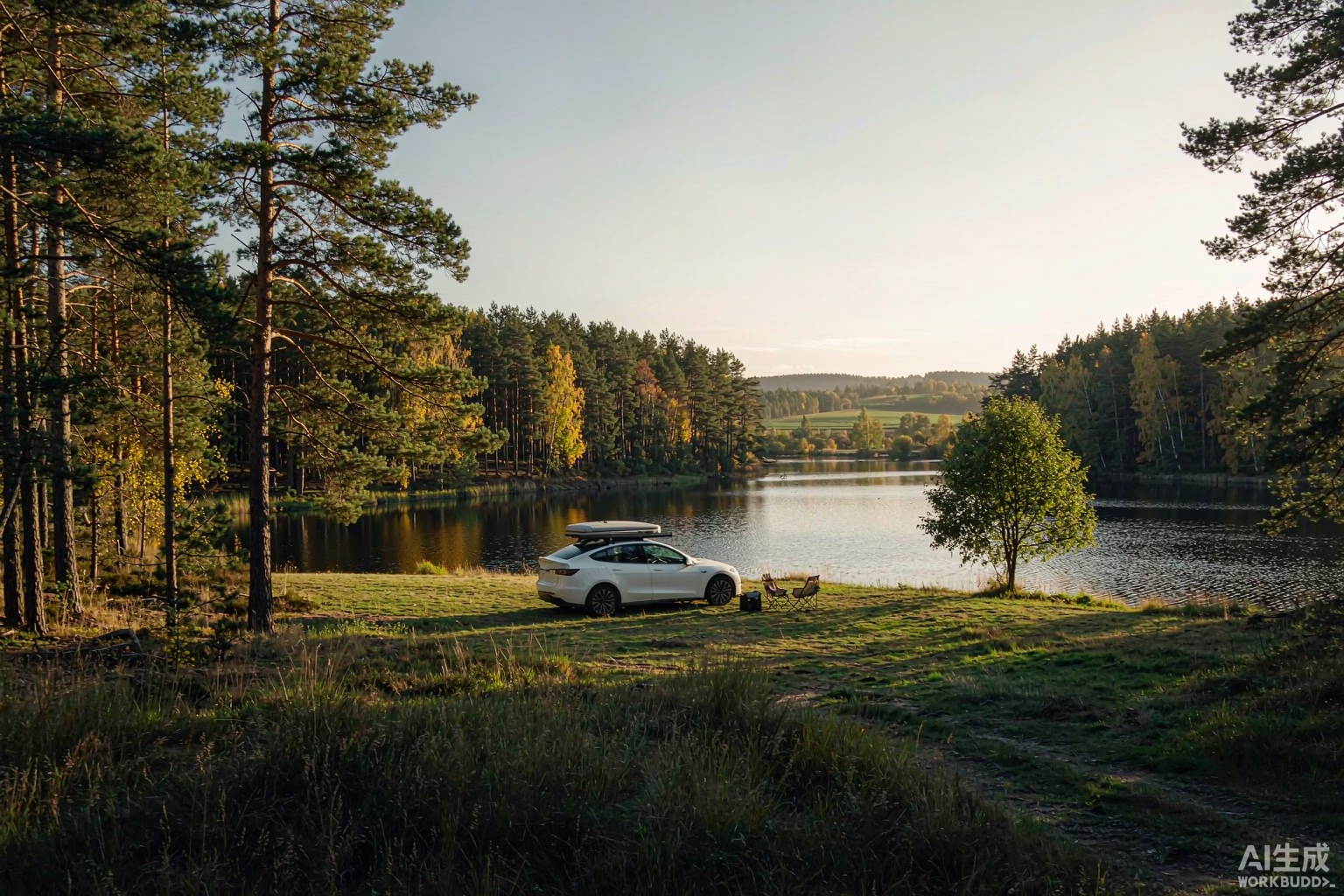
That is a big number and a very long horizon. But it is also a useful reminder of something closer to home: the car coming out of the existing hall is already the best camping car Tesla makes, and there is a great deal of empty forest and lake within an hour of the factory gate.
What Tesla actually confirmed
Asked by rbb and the Märkische Oderzeitung on 14 October, Tesla said its 2023 application had already set out a staged expansion of Gigafactory Berlin-Brandenburg and its environmental effects, that the permit notice of 15 October 2024 “established that it is permissible in principle”, and that the planned partial-permit application for the northern production building builds on that.
The figures around it, per rbb:
- New hall: about 536,000 m², against roughly 219,000 m² for the current building – about 2.45 times the size
- Application expected in December 2026
- Possible construction start in 2027, with the full expansion laid out over about ten years
- Long-term target: 500,000 to 1,000,000 cars a year, and battery cell capacity from 50 to 100 GWh
- Also in the package: a dedicated electrical substation, another water recycling loop and expanded on-site wastewater treatment
Water has been the sore point at Grünheide since before the plant opened, so that last part matters locally: Tesla’s position is that total water use rises but no additional sanitary wastewater leaves the site.
The gap between the plan and today
Be careful with the million. Grünheide built about 202,000 cars in 2025, against installed capacity of roughly 375,000 – around 54% utilisation. It is only this month that the plant is moving to a rate of 7,500 Model Y a week, which annualises to about 390,000 if nothing ever stops. Getting to a million from 202,000 means output rising nearly fivefold. One million is a design capacity for sometime in the 2030s, not a forecast for 2027.
Which raises the obvious question: why build a second hall when the first one is not full? The common reading is that the new space is for a different vehicle. Musk said earlier this year that the Cybercab is the most likely next major product for Giga Berlin, with Optimus possibly after it. Installing the equipment needs a further permit in any case.
Why campers should care about a Cybercab
Because it is worth being clear-eyed about what a “next product” means for anyone who sleeps in their car. The Cybercab has two seats, butterfly doors and no usable boot – there is no version of it that carries a tent, a fridge or a wet dog. If the new hall ends up building robotaxis, the camping car remains the one being built next door, and the practical effect of a bigger Grünheide is simply this:
- More Model Ys on European roads, which means a deeper second-hand market in three or four years
- A bigger installed base, which means more accessories, more third-party kit and more campsites that have stopped treating an electric car as unusual
- Spare parts and service that get easier to find, not harder
The camping within an hour of the factory
Grünheide sits in Brandenburg, which is not a place most people plan a holiday around and probably should be. It is an hour from Berlin and on the edge of some of the flattest, quietest, cheapest camping in Germany:
- Märkische Schweiz – Germany’s smallest nature park, beech forest and small lakes, an easy first trip
- Spreewald – a UNESCO biosphere reserve of canals and river channels; October is the last calm month before the punting crowds return
- Mecklenburg Lake District – further north, but a couple of hours gets you into the Müritz area with hundreds of lakes and navigable waterways
Nights are already down to a few degrees, which is exactly the condition Camp Mode is good at: a sealed cabin held at temperature all night, no gas, no exhaust, no generator noise, and a heat pump rather than a resistive heater eating the battery. Off-season pitches in the east are also among the cheapest in the country.
What turns a cold car park into a campsite is still the kit:
- Tesla Roof Top Tent – a bed above the wet ground, set up in minutes, packed away wet without drama
- Tesla Inflatable Air Mattress – or sleep inside the car and keep the boot free for everything else
- 2048Wh LiFePO4 Portable Power Station – 2048Wh for lights, pumps and phones, so the car still has enough charge to leave in the morning
- 35L Dual-Zone Compressor Fridge – dual zone, so one side is drinks and the other is food that still survives day three
- Magnetic Mesh Bug Screens – fresh air at night without everything that flies
- Tesla Trunk Organiser Box – because a 2,000-litre boot is chaos by the second morning
- Tablet Mount Holder – navigation, weather warnings and the pitch you booked an hour before you arrived
A second hall, a ten-year plan and a million cars a year. Nice for Brandenburg, nice eventually for the used market. In the meantime, the car in the existing hall will get you to the lake tonight.