Europe Just Hit 44% Electric Cars in a Single Month – and Your Campsite Will Never Look the Same

Here is a number that would have sounded ridiculous three years ago. In September 2026, 44 out of every 100 new cars registered across Europe’s nine biggest markets were electrified. Not “plug-in curious”. Forty-four per cent.
That is an all-time high, and it happened on a single month’s registrations. If you camp in Europe, this is not a car-industry statistic. It changes what the campsite looks like when you arrive.
The September numbers
Across the nine markets that report monthly, 477,400 electrified cars were sold in September. That is up 50.9% on a year ago and up 83.7% on August, with penetration at 44.0% – a jump of 11.5 percentage points year-on-year.
Country by country, September 2026:
- United Kingdom – 158,800 sold, +43%, 45.3% penetration
- Germany – 116,500 sold, +59%, 45.4%
- France – 74,700 sold, +84%, 47.7%
- Spain – 31,900 sold, +56%, 34.0%
- Italy – 26,500 sold, +45%, 18.7%
- Sweden – 20,300 sold, +18%, 70.9%
- Norway – 18,600 sold, +31%, 99.0%
- Denmark – 17,800 sold, +34%, 88.9%
- Portugal – 12,400 sold, +53%, 63.1%
And it is not a one-month blip. Between January and September, 2,919,800 electrified cars were sold across those same markets, up 39.6%, with cumulative penetration at 36.24% – eight and a half points higher than last year. Analysts have now raised their full-year forecast to more than 5.5 million cars, roughly 37% growth.
Tesla itself grew 77.3% in the month and took 11.7% of the market. Worth saying out loud: take Tesla out entirely and everyone else still grew 48%. This is not one brand having a good month. The whole market moved.
Why it happened: governments started paying again
This is the part people forget. The surge is heavily policy-driven:
- Germany restarted a purchase subsidy worth €3 billion, and it applies retroactively to cars registered since 1 January 2026
- Spain finally opened the claims window for its Plan Auto+ scheme, releasing months of pent-up orders
- the UK enlarged its direct grant fund at the end of 2025, and the effect has been building all year
- France launched a new social-leasing scheme in July, on top of continued purchase support
Which also means the obvious caveat: when subsidies run out, growth can stall again. Portugal is the interesting counter-example – its second-phase incentive ended in July and it still grew 53% in September.
Three honest caveats
First, “electrified” includes plug-in hybrids. The 2026 mix so far is about 68% battery-electric, 32% plug-in hybrid, so the pure-electric share is meaningfully lower than 44%.
Second, these are the nine countries that report monthly – not the whole of the EU. And registration data is lumpy. Look at the UK’s +280% month-on-month change: nobody bought three times more cars because they suddenly wanted them. Plate-change cycles and Tesla’s quarterly delivery rhythm move numbers around by months.
Third, the 5.5 million figure is a broker forecast, not a result. Treat it as an estimate.
What this actually means when you pitch up
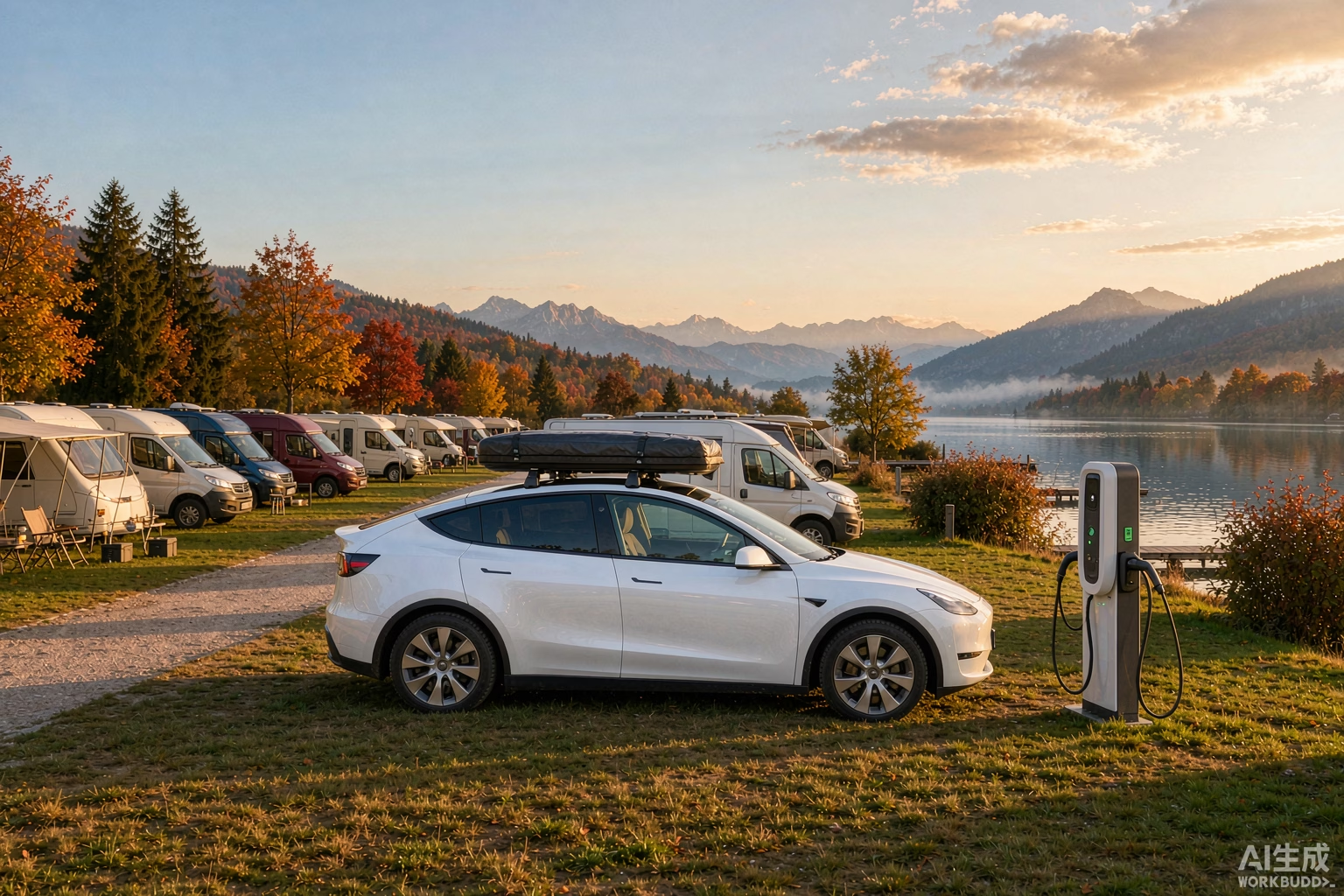
You will not be the only electric car on the field. Sites are adding charge points because they now have to – but demand is growing faster than the sockets. When you book, ask two questions: do you have charging on site, and can I reserve it? And the obvious courtesy: never park in a charging bay and leave.
The electric countries are the camping countries. Look at that list again. Norway at 99% and Sweden at 70.9% are the home of the right to roam – free camping in the wild is a legal tradition there, not a rebellion. Denmark at 88.9% is the country that passed 100,000 Teslas this year. Portugal at 63.1% is the Algarve, which is where half of northern Europe spends the winter. Turning up in a Model Y in any of them makes you completely unremarkable. That is a good thing: it means chargers, and it means no one stares.
The used market is coming. Nearly 2.9 million electrified cars sold in nine months means that in two or three years there will be a deep, cheap secondhand Model Y market. If Tesla camping feels out of reach at new-car prices, the maths looks very different on a three-year-old car – and the boot space is identical.
The kit that makes it work
None of this needs a motorhome. A Model Y with the seats down gives you more than 2,000 litres of flat floor, and Camp Mode keeps the cabin at temperature all night with no exhaust, no gas and no generator hum. From there:
- Tesla Roof Top Tent – a proper bed off the ground, away from damp and slugs, and it packs down in minutes
- Tesla Inflatable Air Mattress – the alternative if you would rather sleep inside the car and keep the boot for gear
- 2048Wh LiFePO4 Portable Power Station – runs the lights, the pump and your phones for a weekend without touching the car battery
- 35L Dual-Zone Compressor Fridge – cold food on day three instead of warm food on day two
- Tesla Trunk Organiser Box – because a 2,000-litre boot becomes chaos by the second morning without one
- Magnetic Mesh Bug Screens – fresh air at night without the midges
Europe did not just buy electric cars this year. It bought them in the countries where people actually camp – which means the next time you book a pitch, you will be plugging in next to someone doing exactly what you are doing.