Europe Fell in Love With Slow Camping – and Your Tesla Was Built for the Long, Quiet Stay

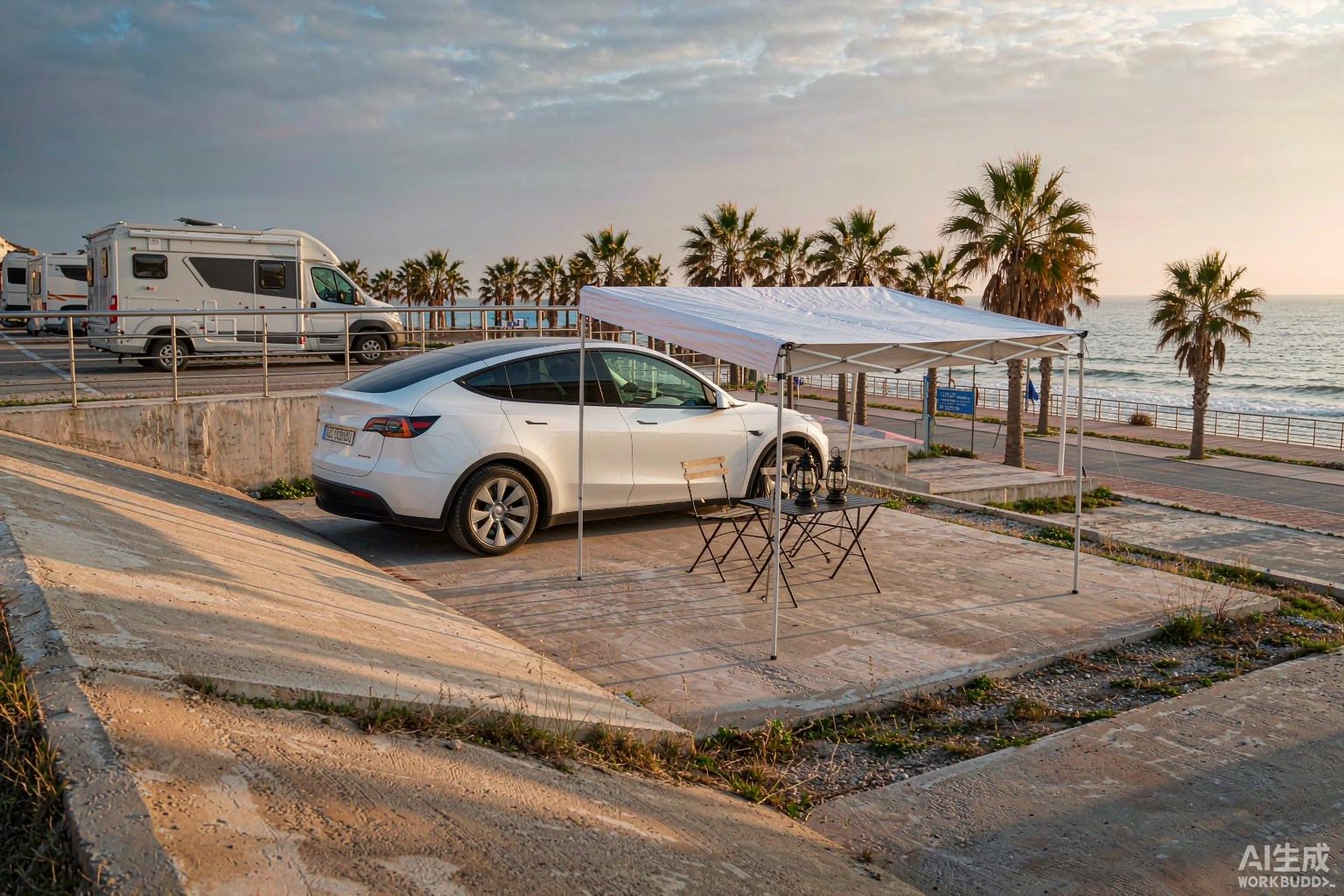
There’s a change happening in European camping that isn’t about gear, or apps, or electric vehicles. It’s about time.
People are staying longer, moving less, and going in October.
The numbers behind the slow-camping boom
DERTOUR’s 2026 Trend Report puts it plainly: 53.2% of European travellers now say they prefer slow travel. Nearly six in ten say they choose a slower pace simply to enjoy the place without rushing, and 52% say it’s about protecting their wellbeing and lowering stress.
The solo traveller is the sharp end of this:
- Solo travellers stay 10.4 days on average, against 8.9 days for travellers overall
- 65% of solo travellers book outside July and August, against 56% overall
- Almost half – 48.9% – say the point of the trip is to get off social media
- Around a third of people are considering going alone: 36.1% in Germany, 35% in Sweden, 32.2% in France
And it’s not just single people. A quarter of people in a relationship, and a quarter of married people, are planning to take a trip on their own.
Campsite networks are already seeing it on the ground. Flower Campings recorded a 110% jump in stays of seven nights or more in the off-season, and 39% more stays of three to six nights. CAMPING-CAR PARK logged more than one million overnight stays in the 2025 off-season, up 11% on visitors, driven by a 25% increase in international guests.
September and October used to be when you packed the tent away. Now they’re when the adults go.
Winter sun, from 16 pounds a night
The Caravan and Motorhome Club has leaned into it hard for 2026/27: more than 7,000 additional site nights across 91 campsites in 12 countries, with long stays of up to three months, starting from 16 pounds per pitch per night for two adults.
- Alannia Els Prats, Costa Daurada (Spain) – from 16 pounds a night on stays of 61 nights or more, beach access, gym and spa
- Taiga Puerto de Santa Maria, Andalucia – from 21.75 pounds a night on 61+ nights, in the sherry triangle between Jerez and Cadiz
- Vilanova Park, near Barcelona – from 23.42 pounds a night on 30+ nights, with the city on the doorstep
- Vagueira, Aveiro (Portugal) – from 22.83 pounds a night
- Turiscampo, Algarve (Portugal) – from 25.86 pounds a night
Brittany Ferries is also running a member offer of up to 80 pounds off – 40 pounds per leg on Spanish routes and 25 pounds per leg on French routes – but only for bookings made between 13 and 30 October 2026, for travel up to 1 November 2027. If a long winter escape is even half a plan, that’s a window worth putting in the diary this week.
Why a Tesla is the right car for a three-week stay
A long, slow trip has completely different requirements to a weekend. You’re not trying to get there fast. You’re trying to live well for two or three weeks without spending much. And that is almost exactly what a Model Y is designed to do.
The drive down is cheap. On 2 October 2026 Tesla’s Supercharger network passed 9,000 locations and 85,000 stalls worldwide – numbers its own charging boss confirmed were close to Tesla’s internal count. Around 2,700 stalls opened in the third quarter alone, 15% more than a year earlier, and the network delivered 2.4 TWh between July and September, up 29% year on year.
Europe is the second-biggest piece of that map, with 22,574 stalls – about 27% of the whole network, second only to North America. And 5,622 sites, roughly two thirds, are open to non-Tesla electric cars too, so the car you’re travelling with isn’t the constraint.
Two things happened this month that are worth knowing if you’re plotting a route:
- Ireland opened its 100th Supercharger, and its largest – a 12-stall V4 hub at the N4 Axis Centre in Longford, up to 250 kW, open to every EV. Tesla also cut non-member charging prices by 15% at a number of Irish sites.
- On 6 October, bp and Aral added more than 20,000 Tesla Superchargers – including 2,000 in the UK – to their Fuel & Charge roaming network, taking it past one million charge points in Europe. If you drive a company car or a fleet vehicle, your existing fuel card may now work at a Supercharger.
You can take the cheap pitch. This is the bit that actually saves money. A serviced pitch with an electric hook-up costs meaningfully more than a basic one – often 10 to 20 euro a night. Over a three-week stay, that’s the price of a fridge. With 2048Wh LiFePO4 Portable Power Station in the boot you don’t need the hook-up at all: it runs the lights, the pump, the laptops and the kettle all evening, and charges while you drive.
You can eat properly for three weeks. A 35L Dual-Zone Compressor Fridge is the difference between a real shop once a week and a daily drive to a supermarket. Dual zone means one side is a fridge and the other is a freezer, which matters when you’re staying somewhere for a month.
You sleep properly, too. For a long stay, off the ground is better: a Tesla Roof Top Tent gives you a dry, flat, ventilated bedroom that takes minutes to put up and doesn’t care if the pitch is muddy. On milder nights, or in a spot where a roof tent is too conspicuous, the Tesla Inflatable Air Mattress turns the flat boot floor into a real bed in under five minutes.
Cooking and living. The Tesla Induction Cooktop handles proper meals without gas, which matters when you’re somewhere for weeks – and on the Costa Daurada in January you’ll be eating outside more than you expect. Magnetic Mesh Bug Screens keep the evening air moving through the car without letting insects in, which is the single biggest comfort upgrade on a long stay in the south. Tesla Trunk Organiser Box is what stops a three-week trip from becoming a permanent rummage, and Tablet Mount Holder puts the screen where you can actually use it for route planning and evening films.
The catch – and it’s a small one
Long off-season stays mean cool nights. Camp Mode will hold the temperature all night, but it is not free: budget a slice of battery for it, and don’t roll into a 61-night stay assuming you’ll be charging every day. Most long-stay sites will let you run a hook-up; if you’d rather not pay for one, the power station covers the evenings and the car covers the driving.
Also: check the site is actually open. Plenty of European campsites still shut between late September and early November, and the good winter-sun ones get booked early for exactly that reason.
The short version
Europe has decided it would rather stay somewhere for ten days than tick off five places in five. The campsites have worked it out – longer stays, off-season rates, winter sun from 16 pounds a night – and the charging map is now dense enough that the long drive down is the easy part.
Go slowly. Stay longer. Leave the phone in the glovebox.