Tesla Just Turned the Model 3 and Model Y Into a Real Mains Socket — Here’s What That Means at the Pitch

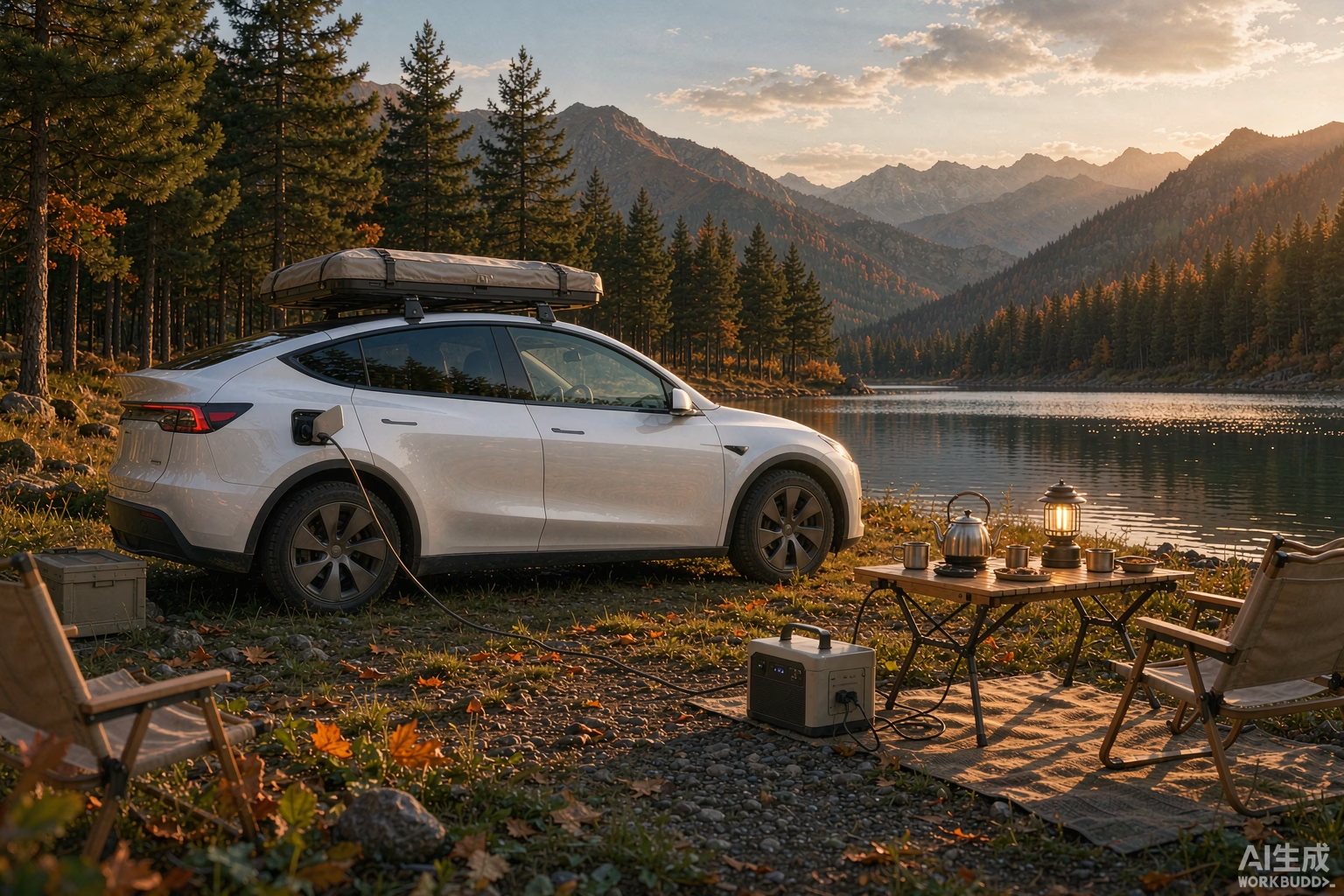
Alongside the 1 October 2026 Model 3 update — a new 16-inch centre touchscreen, a black fabric headliner and a light grey interior option — Tesla quietly switched on something far more interesting for anyone who sleeps in their car. Both the Model 3 and the Model Y now support AC external power discharge. In plain language: your Tesla is now a mains socket.
You plug a separate adapter into the charge port and get ordinary household AC out of it — up to 2.2 kW at 220V, enough to run a portable rice cooker (about 600 W), a hot pot (about 1 kW) and a kettle (about 600 W) at the same time. The car’s screen shows discharge power and remaining range while it runs, so you can see what you are spending.
What 2.2 kW Actually Gets You
This is the number that matters, because 2.2 kW is a real, usable amount of power — and also a hard ceiling. It is not a house generator.
| What you plug in | Rough draw | Fits in 2.2 kW? |
|---|---|---|
| String lights, phone/laptop charging | 20–100 W | Easily — barely registers |
| Kettle | ~600 W | Yes |
| Induction hob / portable cooktop | ~1,000–1,800 W | Yes, but not with the kettle at the same time |
| Compressor camping fridge | 40–60 W running | Yes — and it cycles, so it costs little |
| Projector + speaker | 150–300 W | Yes |
| Fan heater | ~2,000 W | Only just, and it eats the entire budget by itself |
| Hair dryer / electric grill | 1,800–2,200 W+ | Borderline — and a bad idea off a car battery |
The rule of thumb: heat is expensive, everything else is cheap. Boiling water and cooking are fine. Heating air is not, and it will show up in your range.
The Honest Catch for European Owners
Three things you need to know before you get excited, and we would rather say them plainly:
- It is not confirmed for Europe yet. V2L is live on the Model 3 in China, Australia, New Zealand and South Korea, and Tesla has expanded Model Y support to all variants in the markets where it is enabled. There is no confirmed launch date or adapter price for Germany, Austria or Switzerland. A later European rollout looks plausible given the pattern, but it is not announced.
- Older Model 3s will not get it by update. Tesla appears to be tying the feature to newer hardware, and older cars are not expected to gain it through software or an official retrofit. This is a hardware thing, not a waiting-for-the-update thing.
- You need the adapter. The capability sits behind a separate Tesla Outlet Adapter that is sold on its own. The car alone does not have a socket.
So: if you own a recent Model 3 or Model Y in one of the enabled markets, this is live now. If you are in Europe, treat it as coming rather than here — and plan this winter accordingly.
The Camping Version: Why This Matters More Than It Sounds
Because the single most boring, most consistent complaint about camping in an electric car is not range. It is the pitch with electricity costs more than the pitch without it.
Anyone who has booked a basic grass pitch and then paid to upgrade to one with hook-up knows the maths. Across Southern Europe, that upgrade is routinely €10–20 a night. Over a long off-season stay that is real money — and now that campsites in Spain and Portugal are running winter-sun long-stay programmes from around £16 a pitch per night for stays of two months or more, the difference between the basic pitch and the serviced one across a whole winter is the price of a decent holiday.
A car that can produce 230V changes the arithmetic completely. You book the cheap pitch, you bring your own electricity, and you go where the hook-ups are not. That includes the small municipal sites, the farm stops and the off-grid pitches that never wired up in the first place.
What to Plug In — and What to Use Until Europe Gets It
The sensible way to think about this: the car is the big battery, and you want a smaller one as the buffer. You do not want to wake up having spent 30% of your range on a kettle and a film.
- 2048Wh LiFePO4 Portable Power Station — 2048Wh of LiFePO4 covers a weekend of lights, phones, a projector and a fridge on its own, and it means the car’s battery stays a car battery. Recharge it while you drive. If European V2L never arrives for your car, this is your campsite mains, and it works today.
- Tesla Induction Cooktop — induction, 230V, no gas bottle and no naked flame near tent fabric. Roughly 1–1.8 kW, which is exactly the kind of load a 2.2 kW outlet was designed for.
- 35L Dual-Zone Compressor Fridge — draws about as much as a laptop and cycles on and off. This is the appliance that pays for the whole setup: real food, bought once every three or four days instead of every day.
- Tesla Trunk Organiser Box — once you are carrying an adapter, a cooktop and cables, the boot needs to be organised or you will spend twenty minutes finding the kettle.
- Tesla Roof Top Tent — the reason you can take the cheap, unserviced pitch in the first place.
- Tesla Inflatable Air Mattress — for the nights when the weather is good and nobody wants to put anything up.
- Magnetic Mesh Bug Screens — fresh air without insects, which matters more on the warm southern pitches you can now afford.
The Bottom Line
Tesla has turned the Model 3 and Model Y into a 2.2 kW, 230V power source — a real socket at the pitch, not a gadget. It is live today in China, Australia, New Zealand and South Korea, and Europe has neither a date nor a price. Older Model 3s look unlikely to get it at all. But the direction is unmistakable: the car stops being just the thing that gets you there and becomes the thing that powers the camp when you arrive. Until the European switch flips, the 2048Wh LiFePO4 Portable Power Station does the same job today, in every country, on every model — and paired with the Tesla Induction Cooktop and the 35L Dual-Zone Compressor Fridge, it turns the cheapest pitch on the site into the best one.