Tesla Just Added 5 More Superchargers to Europe — and Your Camping Map Just Got Bigger

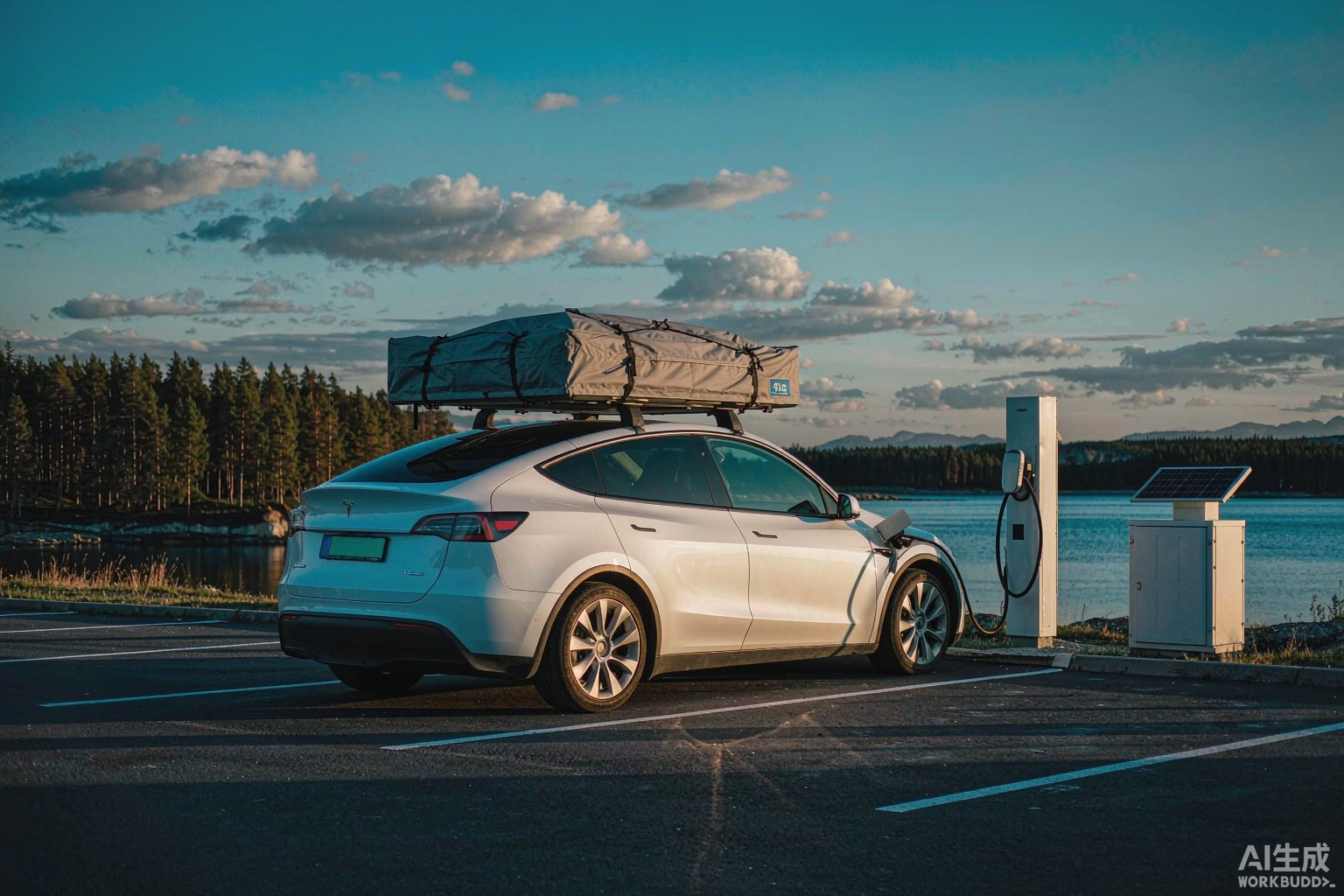
For years the one worry that stopped people taking a Tesla deep into the wild was simple: “Will I find a charger?” That worry is quietly evaporating. In the single week ending 7 September 2026, Tesla filed plans for five brand-new Supercharger sites across four countries — France, Germany, Denmark and Poland — and two of them landed in Denmark at once, a clear sign Tesla is racing to beef up Nordic coverage before winter.
Here is what actually moved, and why it matters if you like sleeping where the road runs out.
The 5 New Sites in Planning
- Saint-Jean-de-Luz, France — a coastal Basque town on the A63 near the Spanish border. It fills a real gap on the Bordeaux–Irun corridor, the busy cross-border run between France and Spain.
- Aschaffenburg, Germany — at the A3/A45 junction east of Frankfurt, tightening the network on the main spine toward Würzburg and Nuremberg.
- Hvidovre, Denmark — on the doorstep of Copenhagen, serving the capital and drivers arriving from the south before the Øresund Bridge to Sweden.
- Nørresundby, Denmark — the northern twin of Aalborg, covering the top of the Jutland peninsula near the E45. Two Danish entries in one week is unusual.
- Poznań, Poland — a major logistics hub on the A2 Berlin–Warsaw corridor, a high-value site for both Polish owners and transit traffic toward the Baltic states.
“PLAN” status means Tesla has formally filed site plans — permits and grid-connection paperwork are in motion — but the stalls are not open yet. Historically it takes weeks to a few months to go from plan to live. The point is the direction: the map keeps filling in.
Why This Is a Camping Story
Most of these new sites are not in city centres — they sit on the motorway corridors that lead to the lakes, coasts and forests where you actually want to camp. A Supercharger near the Spanish border means the Pyrenees are an easy loop. One by the Øresund Bridge means Sweden’s west coast and its granite coves are a single charge away. A site on the A2 means the Polish lake district is finally painless.
And remember the network has been open to any CCS-compatible EV since late 2023, so even if a friend joins in a non-Tesla, they can top up at the same stalls. Tesla is also mid-rollout of its faster V4 cabinets across the continent, which charge quicker and fit more vehicle types.
Plan Around the Charger, Not the Other Way Round
- Top up while you eat. Plug in at a Supercharger, grab lunch, and you are usually full before the bill arrives — the classic trick that makes an EV road trip no slower than a fuel car.
- Recharge your gear too. A 2048Wh LiFePO4 Portable Power Station slides into the boot and tops back up every time you charge the car, so your fridge, kettle and devices never go flat at the campsite.
- Watch peak-season queues. On the Côte d’Azur in August or the Italian lakes on summer weekends, charge an hour either side of the 12–18h rush.
- Sleep above it all. A Tesla Roof Top Tent keeps you off the damp ground and ready to roll the moment you unplug.
The Practical Kit
A growing charger network is half the equation. The other half is arriving self-sufficient:
- A 35L Dual-Zone Compressor Fridge keeps food safe for days on a remote site with no hookup.
- The 2048Wh LiFePO4 Portable Power Station is your off-grid power bank, recharged free every time you stop.
- A Tesla Inflatable Air Mattress turns the cabin into a flat, warm bed for stormy nights.
- Magnetic Mesh Bug Screens let you crack the windows for air without the midges.
- A Tablet Mount Holder holds your route and the charger map in view without blocking the windscreen.
The Bottom Line
Five new Supercharger plans in one week will not make the evening news, but for a Tesla camper they are the best kind of quiet progress. The gaps that used to force careful maths are filling in — the Pyrenees, the Danish north, the Polish lakes. Pair the bigger map with a portable power station and a compressor fridge, and the only planning left is deciding where to point the car first.