How to Keep Your Tesla Charged While Camping Across Europe in 2026

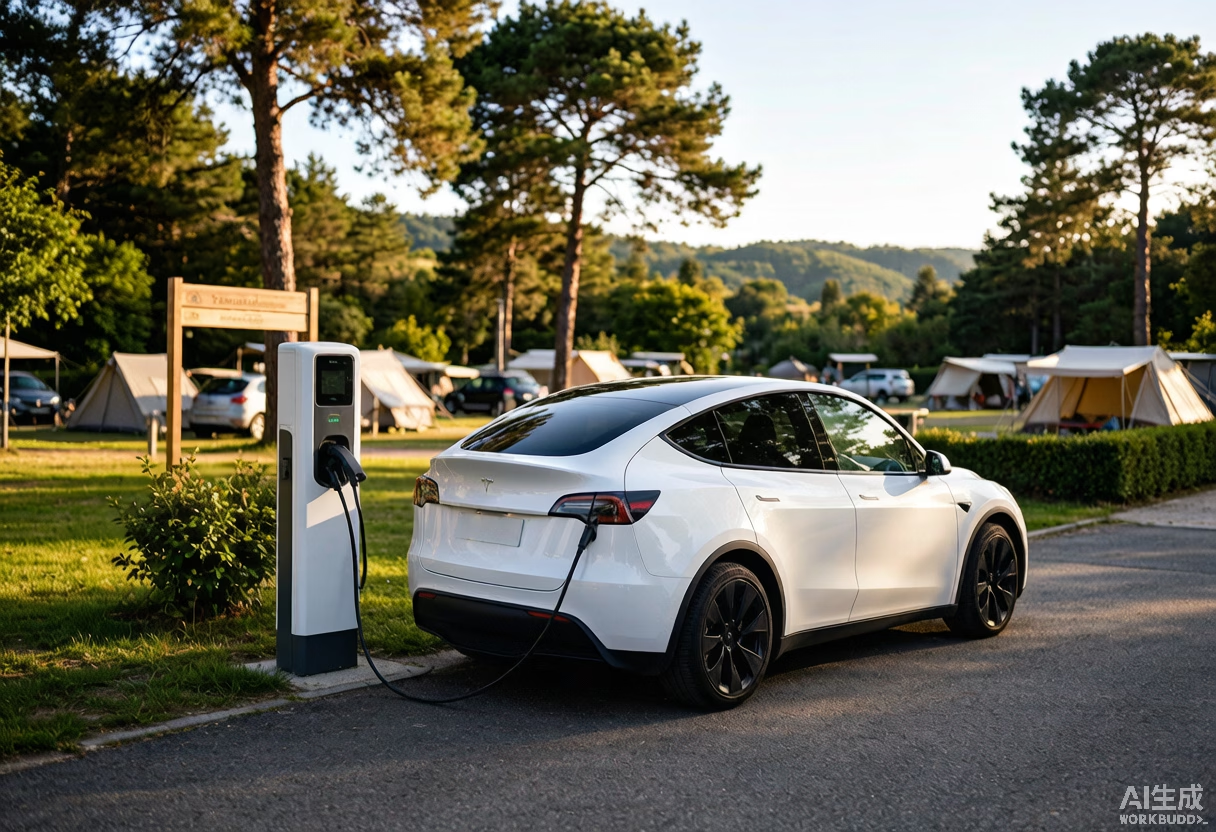
One question comes up more than any other from Tesla owners planning their first European camping trip: “How do I charge the car at the campsite?” It is a fair question. You arrive after a long drive, you want to set up Camp Mode for the night, and you need the battery full again by morning. The answer has changed a lot in the last two years. Here is what actually works in 2026.
The short version: most proper campsites now have dedicated EV chargers at the entrance car park, and plugging into anything else is not just against the rules — it is genuinely dangerous. Let me walk you through the options, the costs, and the one thing that will save you money on every single night.
The Golden Rule: Never Plug Into a Pitch Socket
This is the rule that catches people out every summer. At virtually every major campsite chain in Europe — Eurocamp across France, Italy and Spain, Camping & Caravanning Club sites in the UK, Italian Europing campsites — it is strictly forbidden to plug your Tesla into the electrical socket on your pitch, mobile home, or bungalow.
There are three good reasons:
- Fire risk. Holiday-home wiring is designed for lights, a fridge and maybe a kettle — not the sustained high-amperage draw of an EV battery. Overheating cables are a real fire hazard.
- Circuit tripping. One EV on a shared circuit can trip the breaker for your entire unit and your neighbours. Some campsites now issue fines for unauthorised connections.
- It counts as electricity theft. In several countries this is explicitly illegal under local campsite regulations and can result in an on-the-spot fine or being asked to leave.
The correct approach is simple: use the dedicated charging station at the campsite entrance. More on that below.
Campsite Charging: What to Expect in 2026
The good news is that campsite EV infrastructure has improved dramatically. Here is the current state of play:
Dedicated Type 2 AC Chargers (The Standard)
Most medium-to-large campsites now offer Type 2 AC chargers in the entrance car park. Typical specs:
- Power: 7 kW (single-phase) or 22 kW (three-phase)
- Payment: Contactless bank card (thanks to the EU AFIR regulation — see below)
- Cost: Around €0.35–0.50 per kWh (varies by site; some French sites charge €0.40/kWh)
- Availability: First-come, first-served. Once charged, move your car to your pitch so others can use it.
A 7 kW charger overnight (say 10 hours) delivers roughly 70 kWh — enough to fully recharge a Model Y Long Range from near-empty. A 22 kW charger does the same job in about 3 hours.
UK Caravan Club Sites: The 16A Blue CEE Exception
In the UK, some caravan and camping club sites still allow EV charging from the standard 16A blue CEE pitch hookup, but only with a properly rated Type-2-to-blue-CEE adapter cable (around €30–80). This gives you 2.3–3.6 kW — slow, but fine for an overnight top-up. Key points:
- Always confirm with the site before booking — policies vary widely
- Use only a cable rated for 16A continuous load (standard caravan cables may overheat)
- Test during the day first before relying on it overnight
- Cost: typically £18–30 for a week vs £52–68 using public rapid chargers for the same mileage
What About Superchargers Near Campsites?
Many popular camping regions now have Superchargers within 20–30 km. The strategy that works best:
- Arrive at the campsite with 30–40% remaining
- Plug into the campsite charger overnight (slow but cheap)
- If the campsite has no charger, do a quick Supercharger stop the next morning before exploring
Tesla’s latest software helps here too. The Supercharger Pricing Filter (added in update 2026.14.3) lets you route only to Superchargers with official Tesla pricing, avoiding surprise third-party mark-ups. And Set Arrival Energy (2026.26 Summer Update) lets you pick your target battery percentage from the phone app before you even get in the car — handy when you know exactly how far tomorrow’s drive will be.
The AFIR Game-Changer: Contactless Charging Everywhere
If you travelled around Europe in an EV three years ago, you probably carried a wallet full of RFID cards and apps. That era is ending. The EU’s Alternative Fuels Infrastructure Regulation (AFIR) mandates that all new public chargers above 50 kW must accept contactless card payments. By January 2027 this applies to every 50 kW+ site in the EU.
In practice, this means:
- Ionity (600 kW ultra-rapid): Tap-and-go with any Visa/Mastercard on the A7 corridor, German autobahns, and growing networks in Scandinavia
- Zunder (1,500+ ultra-rapid stalls across Spain, France, Portugal): 24-hour smart stores with coffee, snacks, and even dog areas while you charge
- Fastned (100% renewable energy): Solar-canopied stations in the Netherlands, UK, Germany, Switzerland, and France
- Atlante / Autostrade per l’Italia: 82 new HPC points (up to 400 kW) just activated across 7 Italian motorway service areas, with battery storage and solar canopies. Average spacing between stations is already down to ~50 km, heading toward 30 km by end of plan
The practical takeaway: carry one RFID pass plus your contactless bank card, and you can charge on essentially any network. No more signing up for five different apps before a road trip.
Ferry & Eurotunnel Charging: Don’t Miss the Free Top-Up
If your camping trip involves a ferry crossing or the Channel Tunnel, you have a charging opportunity that many people miss:
- Eurotunnel (LeShuttle): Both Folkestone and Calais terminals have ultra-rapid chargers (up to 210 kW). You can add 150+ km of range in the 30–45 minutes before boarding — essentially free if you factor in the waiting time anyway.
- Ferries (P&O, DFDS, Brittany Ferries): On-board charging is appearing on newer vessels but is not universal yet. Check with your operator when booking. Terminal chargers are reliable.
Pro tip: arrive at the terminal 30 minutes earlier than recommended, plug in, and use the time to grab coffee or stretch your legs. By the time you board, your battery is fuller and your legs are less stiff.
Bison Futé Weekends: When Chargers Get Crowded
France’s Bison Futé traffic forecast flags specific Saturdays when the roads — and the chargers — hit peak load. For August 2026, these are the red-flag days:
| Date | Risk Level | What Happens |
|---|---|---|
| Saturday 8 August | Red | Late summer departures; A7/A10 corridors congested |
| Saturday 15 August | Red | Assumption holiday (Ferragosto); peak of peak |
| Saturday 29 August | Red | Main return week for Paris region |
On these days, fast chargers on the A7 (toward Provence), A10 (toward Bordeaux), and A63 (Atlantic coast) report wait times stretching from minutes to over an hour. Two mitigations that work:
- Shift departure day. Leave Wednesday, Thursday or Sunday instead. You avoid both the road queue and the charger queue.
- Use ABRP (A Better Route Planner) to route via the second- or third-choice charging stop. A 15-minute detour to a quieter site can save 45+ minutes of queuing.
Camp Mode Power Budget: How Much Does Overnight Camping Actually Cost?
Camp Mode is brilliant, but it uses battery. If you are relying on campsite charging (or no charging at all), you need to know the numbers:
| Condition | Camp Mode Drain (8 hrs) | Remaining for Driving |
|---|---|---|
| Mild night (15–20°C) | 6–10% | 90%+ |
| Hot night (30°C+, A/C working hard) | 12–16% | 84–88% |
| Cold night (below 5°C, heating on) | 15–24% | 76–85% |
If you are staying multiple nights without access to a charger, a portable power station makes a real difference. Our 2048Wh LiFePO4 Portable Power Station holds 2048 Wh — enough to run your Tesla Induction Cooktop, charge phones, power lights, and keep essentials going without touching the car battery. Pair it with our 35L Dual-Zone Compressor Fridge for cold drinks and fresh food, and you can go off-grid for 2–3 nights comfortably.
Bottom Line
Charging a Tesla while camping in Europe is straightforward once you know the rules: use the campsite’s dedicated charger, never touch the pitch socket, carry a contactless card for AFIR-compliant networks, and plan around busy Saturday peaks. The infrastructure has never been better, and it keeps improving every month.
For sleeping comfort, don’t forget the basics: a Tesla Inflatable Air Mattress turns folded seats into a proper bed, Magnetic Mesh Bug Screens keeps bugs out with windows open, and a Tablet Mount Holder on the dash lets you check charging apps and navigation without holding your phone. Simple kit, big difference.