September Is the New August: Why Smart Tesla Campers in Europe Are Booking the Shoulder Season in 2026

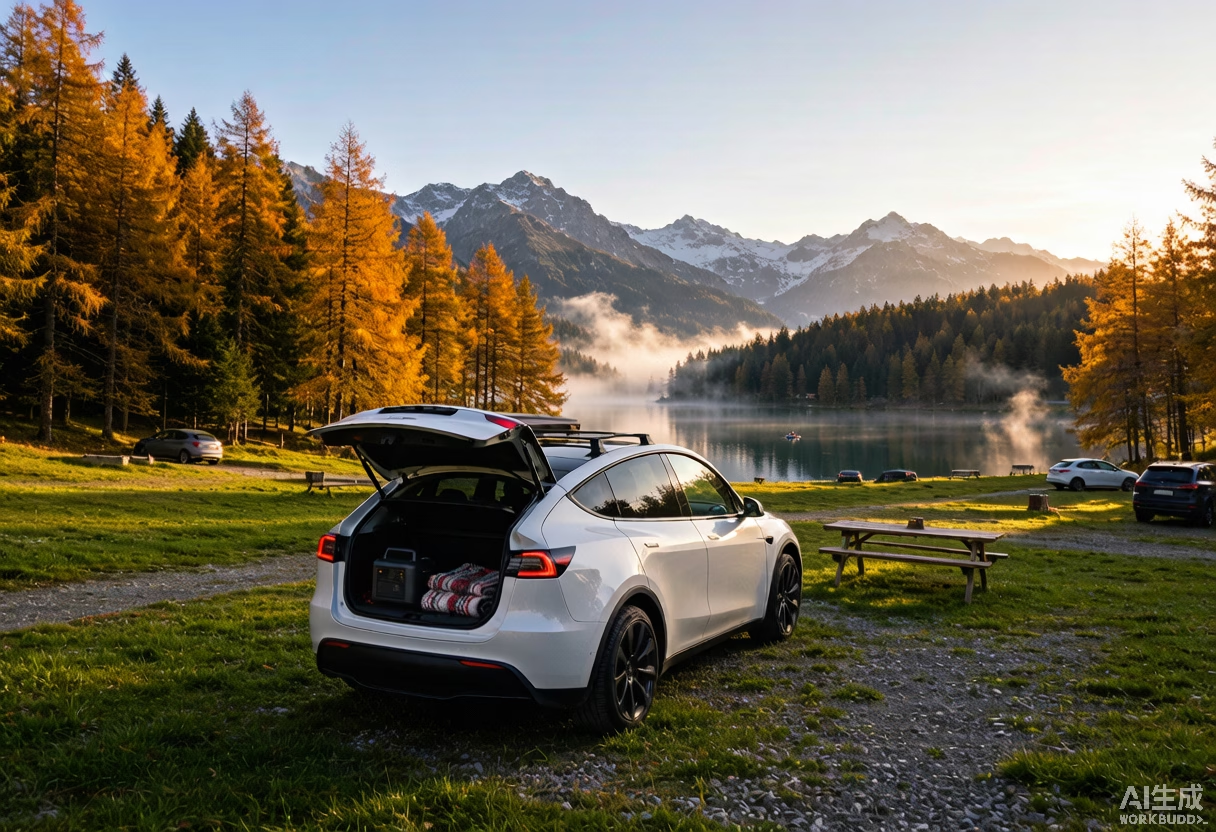
Right now, somewhere on the A7 heading towards Marseille, a family is sitting in stationary traffic in 36°C heat. They booked this week eight months ago because it was the only week they could get off work. They will pay €73 a night for a pitch, queue for a Supercharger, and fight for a spot by the pool.
Meanwhile, a different kind of camper is quietly looking at the calendar and booking the second week of September. Same campsite. Same lake. Roughly half the price, a third of the people, and 10°C less heat.
This is not just a hunch. The booking data for 2026 shows a genuine structural shift in how Europeans camp — and if you drive a Tesla, the shoulder season suits you even better than it suits everyone else. Here’s why, and how to plan it.
The Data: Autumn Is Growing Faster Than Summer
PiNCAMP — the camping portal run jointly by ADAC (Germany), ANWB (Netherlands) and TCS (Switzerland) — analysed bookings across the 2023 to 2026 travel years. The headline finding is simple: the classic summer peak is stagnating while spring and autumn are booming.
Booking growth for autumn (September to October) versus the previous year:
- Northern Europe: +47%
- Central Europe: +5%
- Southern Europe: +4%
And spring (April to June) is even stronger — Northern Europe +53%, Central Europe +25%, Southern Europe +18%. Compare that to high summer (July and August), where Southern Europe actually fell by 2% this year while Northern Europe grew 15%.
“The holiday calendar is being relieved of pressure over time,” says Uwe Frers, Managing Director of PiNCAMP. “Instead of an extreme concentration on a few summer weeks, we are seeing a development towards a longer camping season. Southern Europe is becoming a year-round destination for campers.”
Translated into plain language: the crowds are thinning out in August and spreading into the months either side. The people who moved first are getting the best of everything.
The Money: What You Actually Save
Campsite pricing in Europe is split into high season (typically 1 July to 31 August) and off-peak. The gap is bigger than most people realise.
According to the PiNCAMP Price Analysis 2026, an average high-season night for a family costs €73 in Croatia, €63 in Italy and €58 in Spain, versus €38 in Norway, €40 in Sweden and €41 in Germany. Now shift those same Mediterranean sites into September and the picture changes again.
Some real, published 2026 examples:
| Site / region | July–August | September–October |
|---|---|---|
| Croatian coastal auto-camp (adult, per night) | €12.00 | €10.00 |
| Same site, camper pitch | €14.00 | €13.00 |
| Same site, mobile home per day | €120 | €100 |
| Austrian lakeside campsite (adult) | €11.50 | €10.50 |
| Austrian lakeside campsite (pitch) | €9.50 | €8.50 |
| French / Spanish holiday parks (7 nights, family) | full price | up to –20% |
On top of the base rate, September is when the offers appear. “Stay 7 nights, pay for 6” deals are standard from 1 September at many Adriatic and Alpine sites. Large French and Spanish holiday park operators are advertising straight 20% discounts on September arrivals. Some are running two-for-one mobile home promotions through September and October.
For a two-week trip, the difference between late August and mid-September routinely works out at €300 to €600 for a family — before you count the fuel, tolls and time you save by not sitting in holiday traffic.
Why the Shoulder Season Is Especially Good in a Tesla
Everyone benefits from cheaper pitches and emptier roads. But there are four things that apply specifically to electric car campers.
1. Your range is at its best
September in most of Europe means daytime temperatures of 15–25°C. That is almost exactly the sweet spot for a lithium battery. You are not burning energy on hard air conditioning like you do in a 38°C August, and you are not yet into the cold-weather penalty of November. Real-world motorway consumption in mild conditions is typically 10–20% better than in a heatwave, and DC charging is faster because the pack is not thermally throttled.
2. Supercharger queues basically disappear
The European Supercharger network is now over 80,000 stalls globally, and Tesla keeps adding large sites — including new bk World lounge locations such as Dardilly near Lyon (28 stalls on the A6) and Magnant on the A5 (56 V4 stalls with solar canopies and 24/7 toilets). These sites are excellent in September and painful on 15 August. After roughly the 24th of August, traffic on the main French, German and Italian holiday corridors drops sharply, and the 20-minute wait for a stall on a Saturday morning stops being a thing.
3. Camp Mode gets cheap
Running Camp Mode overnight in a 35°C southern European heatwave costs roughly 12–16% of your battery. In a mild 12–18°C September night, holding a comfortable cabin temperature typically costs 6–10% — sometimes less, because the system barely has to work at all. That means you can genuinely camp two or three nights off-grid without touching a charger.
4. The nights get long again
In late June, it barely gets properly dark in northern Europe. By mid-September you get real, deep darkness by 21:00 — which is when car camping in a glass-roofed Tesla stops being about sleeping and starts being about lying back and watching the sky. Combine that with the clearer, less hazy autumn air and you get some of the best stargazing of the year.
Five Shoulder-Season Routes Worth Booking Now
1. The Dordogne and Lot valleys, France (September)
Warm days, cool nights, river swimming still perfectly pleasant, and the campsites are half empty. Excellent Supercharger coverage along the A20 and A89. Walnut and wine harvest season means the village markets are at their best.
2. Tuscany and Umbria, Italy (mid-September to early October)
The grape harvest, 24–27°C days, and agriturismo campsites that were fully booked in August with space at short notice. Avoid the coast, stay inland, and drive the SR222 Chiantigiana.
3. The Alpine passes, Austria and Switzerland (September only)
This is the window. High passes such as the Grossglockner and the Stelvio are open, the summer coach traffic has gone, and the larches start turning gold at the end of the month. Important: many high passes and mountain campsites close from mid-October, and some Alpine sites shut on 31 October. Check dates before you commit.
4. The Algarve and Alentejo, Portugal (October)
Sea still at 21–22°C, air at 24°C, prices collapsed, and the Atlantic light in autumn is genuinely spectacular. Portugal has become a Tesla-friendly market with solid Supercharger coverage along the A2 and A22.
5. Scottish Highlands and the NC500 (September)
Two enormous advantages over July: the midges collapse after the first cold snap, and the road is no longer nose-to-tail. Bring layers — nights drop to 5–8°C — and be aware that Scottish councils tightened overnight parking enforcement in 2026, so use official stopovers.
What Changes in Your Packing List
Shoulder-season camping is not summer camping with a jumper. The main difference is the day–night temperature swing. A September day in the Alps can be 24°C at 15:00 and 4°C at 05:00. Here is what actually matters.
- Tesla Inflatable Air Mattress — Cold comes from below. In summer you can get away with a thin pad; in September you cannot. A proper thick inflatable mattress with a custom-fit shape gives you both insulation from the cold floor pan and a completely flat sleeping surface. This is the single biggest upgrade for autumn car camping.
- 2048Wh LiFePO4 Portable Power Station — Off-grid nights are much more likely in the shoulder season, because many smaller sites shut down their electric hook-ups or close entirely. A 2048Wh LiFePO4 station runs your lights, phones, laptop, a small heater and the fridge for two full nights without touching the car battery.
- Tesla Induction Cooktop — Hot food matters far more in autumn than in August. An induction cooktop boils water in a couple of minutes for coffee, soup or pasta, works with zero flame and zero smoke, and is allowed in places where gas and open fires are restricted.
- 35L Dual-Zone Compressor Fridge — Counterintuitive, but useful: a dual-zone compressor fridge in autumn works far more efficiently in cool ambient temperatures, so the power draw drops. You can keep the harvest-season produce you buy at markets — cheese, wine, local charcuterie — properly chilled for the whole trip.
- Tesla Trunk Organiser Box — With more layers, more blankets and more cooking gear on board, organisation stops being optional. Keeping the boot structured means the sleeping area actually stays clear when you convert the car at 20:00 in the rain.
- Magnetic Mesh Bug Screens — Condensation is the number one complaint of autumn car campers. Two people breathing overnight in a sealed cabin means streaming windows by morning. Cracking the windows a few centimetres solves it, and magnetic mesh screens let you do that without inviting in the last of the season’s insects.
- Tesla Roof Top Tent — For families or anyone travelling with more than one other person, a rooftop tent doubles your sleeping capacity and keeps you off the increasingly damp autumn ground. It pitches in minutes, which matters when the light goes at 20:00 instead of 22:00.
- Tablet Mount Holder — Longer, darker evenings mean more time inside the car. A properly positioned tablet turns the back of a Model Y into a decent cinema, and it is also how you check the mountain weather forecast before committing to a pass.
Book It Now
The reason to act in the first week of August is simple: the best September pitches at the best sites are being taken right now by people who read the same data. Northern European autumn bookings are up 47%. That growth is coming from somewhere, and it is coming from people who used to travel in August.
If you have any flexibility at all — no school-age children, remote work, or the ability to take leave outside the peak — the shoulder season is the single easiest upgrade to your camping year. Cheaper, quieter, cooler, better for your battery, and objectively more beautiful.
The Mediterranean will still be there in September. It will just have fewer people in it.