Europe’s Perfect Storm: Eclipse + Ferragosto + School Holidays — How to Beat the August Chaos in Your Tesla

August 2026 is not a normal month for European travel. Three major events are converging in a way that has not happened in living memory: a total solar eclipse on 12 August sweeping across Spain, Ferragosto on 15 August (when Italy and much of Catholic Europe effectively shuts down for the year’s biggest holiday week), and every single European country on summer holiday simultaneously from 1–7 August. Add in major motorway construction projects, the usual Bison Futé black-day traffic forecasts and a charging network that — while excellent — was never designed for this level of simultaneous demand.
If you are planning a Tesla road trip anywhere in Europe this month, you need a strategy. This guide covers when to travel (and when absolutely not to), which routes to avoid, how to handle Supercharger congestion, and — most importantly — why sleeping in your car with the right gear beats fighting for a €300/night hotel room in a sold-out coastal resort.
The August 2026 Traffic Calendar: When Every Road Turns Red
European traffic authorities publish colour-coded forecasts each summer. Here is what August 2026 looks like according to France’s Bison Futé, Germany’s ADAC and cross-border data aggregated by Pixidia:
- 1–7 August (Friday to Thursday): BLACK — Absolute peak. Every European country is on holiday simultaneously. An estimated 24 out of 27 regions/countries have schools closed. The A7 (France), A2 (Netherlands), Gotthard (Switzerland) and Brenner (Austria–Italy) corridors operate at or above capacity. Supercharger queues of 30–60 minutes reported at tourist hubs (Côte d’Azur, Lake Garda, Costa Brava).
- 8 August (Friday): RED. Heavy outbound traffic as weekend travellers join those already on the road. The A75 through Massif Central remains the only toll-free escape route that rarely jams.
- 12 August (Tuesday): ECLIPSE DAY. Severe congestion expected on every road leading into Spain’s path of totality from Madrid, Barcelona, Valencia and Bilbao. Authorities advise positioning inside the path the night before.
- 15 August (Friday): BLACK — Ferragosto. Italy’s national holiday. 1.7 million Romans leave the capital alone. French coastal routes hit annual peak. Combined return-trip traffic from the eclipse (12th) and Ferragosto (15th) creates a unique double-surge pattern.
- 16–23 August: ORANGE to YELLOW. Gradual improvement as northern countries (Germany north, Netherlands North, Switzerland German cantons) return to school. Southern Europe (Spain, Italy, France) remains busy.
- 24 August onwards: GREEN. Relative calm on most roads. Southern European destinations still warm, accommodation prices drop sharply. This is the sweet spot for a relaxed Tesla camping trip.
The Infrastructure Squeeze: Roadworks, Tunnels and Bottlenecks
Beyond pure volume, August 2026 has a structural problem: major maintenance projects coincide with peak traffic on several critical corridors:
- A7 (France, Marseille–Septèmes): Bridge reconstruction reduces the motorway from 3 lanes to 2 between Marseille and Septèmes-les-Vallons from 7 July to 28 August. Expect 30–60 minute delays on southbound traffic throughout the month.
- A55 (France, Martigues): Viaduct works from 15 July to 14 August add friction near the Marseille Fos-sur-Mer industrial zone.
- A1 (France, Dourges–Carvin): Fully closed 2–14 August. All Paris–Brussels–Lille northbound traffic must detour via A26/A2.
- Gotthard Tunnel (Switzerland, A2): Single-bore, two-way, 17 km long. Summer weekend queues stretch 10–15 km, adding 60–90 minutes. New free slot-reservation pilot (ASTRA, summer 2026 weekends only) gives booked vehicles a priority lane; early data shows 25% adoption cuts queue times by 40%. EV advantage: idling consumes only 1–2% SoC per hour versus continuous diesel fuel burn. Start the queue with 15%+ SoC minimum.
- Brenner Corridor (A13/A22, Austria–Italy): Extremely overloaded. Rail suspended until 1 August (replacement buses). Plan alternatives via Reschen Pass or Vrš Pass if delays exceed 90 minutes.
- Germany: ADAC reports approximately 1,000 active Autobahn construction zones nationwide. Recommends Monday/Tuesday travel to minimise congestion exposure.
Supercharger Strategy: Charging Without the Queue
The European Supercharger network now exceeds 80,000 stalls worldwide and coverage is excellent across every country you might visit. But in August, location and timing matter enormously:
- Arrive with 10–15%, leave at 80%: The 10–80% window is where DC fast charging is fastest. Arriving too charged wastes time at the stall; charging past 80% adds 10–30 minutes for minimal range gain. Save 100% charges for legs where the next charger is genuinely distant.
- Avoid motorway stations at peak hours: Saturday 14:00–16:00 at Côte d’Azur stations, Sunday morning on the Route du Soleil, any lunchtime (12:00–14:00) near tourist destinations. Shift your stop by one hour earlier or later and the difference is often dramatic.
- Take the exit: High-power charging hubs located 2–3 km off the motorway (supermarket carparks, retail parks) are consistently less crowded, often cheaper and usually have better amenities than cramped service-area stations. Your Tesla’s navigation can route to these if you search by charger name rather than “nearest Supercharger.”
- Combine charging with meals: A 20–25 minute 10–80% session aligns perfectly with a Spanish menu del día, Italian pranzo or German Mittagsessen. You lose zero travel time.
- Precondition en route: Set your Supercharger stop as a navigation destination. Your Tesla warms the battery pack while driving, ensuring maximum charging speed on arrival. Critical in 35°C+ August heat when thermal throttling can otherwise reduce charging speeds.
- Have two backups written down: For every planned charging stop, note one earlier alternative and one later one. Save them as favourites in PlugShare. When your primary station is full or offline (it happens), you do not want to be searching with 12% battery.
Alternative Routes That Save Time, Money and Sanity
When the main corridors jam, these alternatives have proven reliable for EV drivers:
- Route Napoléon (N85 via Grenoble): Scenic alternative to the Rhône Valley (A7/A9). Slower but rarely congested. Chargers available in Gap, Sisteron and Grenoble. Adds ~45 minutes but saves 2+ hours in A7 queues during black days.
- A5 + A31 via eastern France: Troyes, Langres, Dijon. Avoids the Paris orbit and Lyon bottlenecks. Good Ionity/Fastned coverage. Recommended for Germany–Spain crossings that want to skip Paris entirely.
- A75 (Massif Central): Toll-free south of Clermont-Ferrand. One of the least-busy north-south routes in August. Beautiful volcanic scenery. Sparse but adequate charging via Millau, Lodève and Béziers.
- San Bernardino (A13, Switzerland): 50 km longer than Gotthard but almost always clear. New Ionity 300 kW station at Thusis (opened June 2026). Recommended when Gotthard queue exceeds 60 minutes.
Why Car Camping Beats Hotel Hunting in August 2026
Here is the uncomfortable math of August accommodation along popular European routes:
- Mallorca (eclipse week, 11–13 Aug): Budget hotel €150–200/night (normally ₂80–100). Mid-range €250–400 (normally ₂120–180). Luxury €500+. Many properties fully booked since 2024.
- Côte d’Azur (Ferragosto week): Standard 3-star hotel €200–350/night. Sea-view premium adds €100+. Minimum 3-night stay requirements common.
- Lake Garda / Dolomites: €180–280/night average. Fully booked weekends through August.
- Total for a 7-night August road trip: €1,400–2,500 in lodging alone, before food, tolls and charging costs.
Now compare with Tesla car camping. With the right accessories, your vehicle becomes a self-contained travel unit:
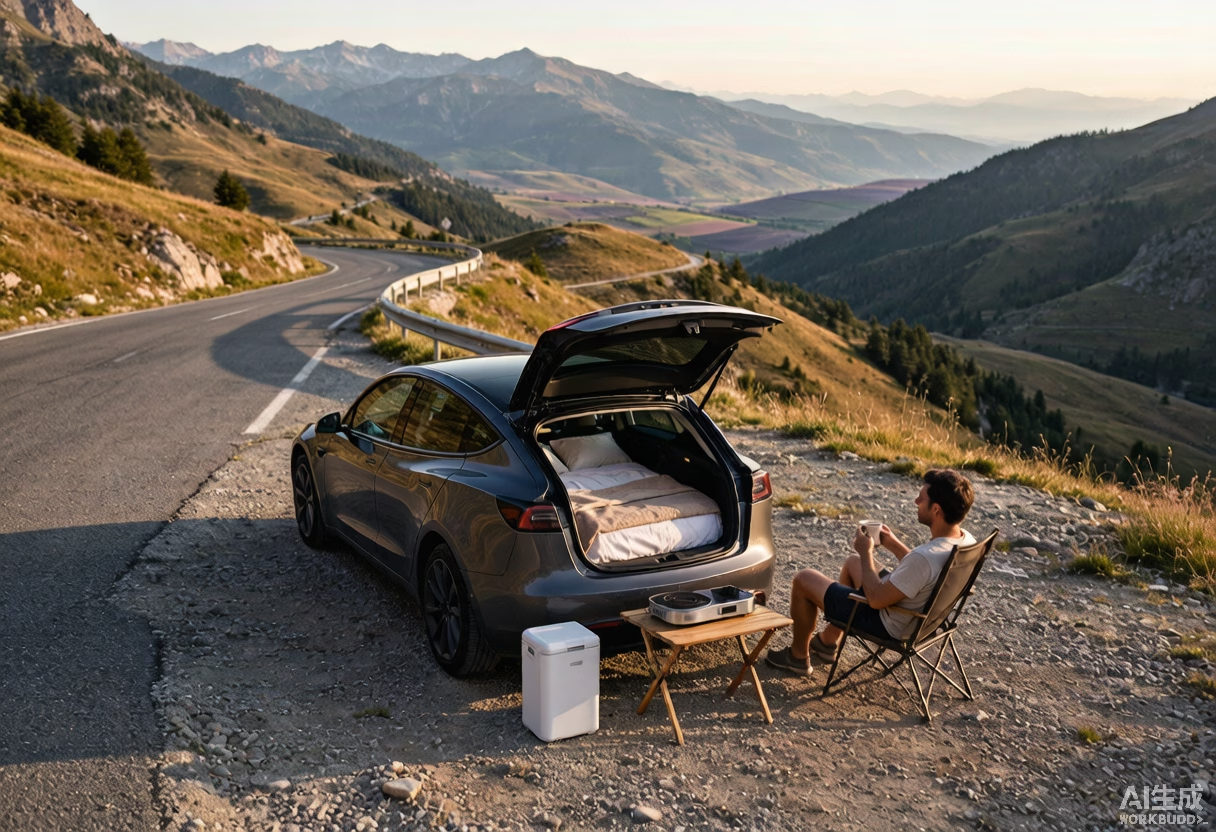
- Tesla Inflatable Air Mattress: Transforms your Model Y or Model 3 flat boot floor into a proper double bed. No air mattress hissing, no ground dampness, climate control integrated.
- Tesla Roof Top Tent: For travellers who want more space or headroom, a roof-top tent elevates your bedroom above the car with panoramic views. Ideal for multi-night stops in scenic locations like the Picos de Europa or Val d’Isère.
- Tesla Induction Cooktop + 35L Dual-Zone Compressor Fridge: Full outdoor kitchen capability. Cook breakfast at a mountain pass overlook, keep drinks cold all day, prepare dinner at a lakeside pull-in. Zero reliance on restaurant availability or opening hours.
- 2048Wh LiFePO4 Portable Power Station: Multi-night off-grid confidence. Two full nights of normal camping power draw (cooking, fridge, phones, lights) from a single charge. Recharges while driving between locations.
- Tesla Trunk Organiser Box: Keeps everything organised. Cooking kit in one compartment, electronics in another, clothes compressed in a third. No living out of duffel bags on the car seat.
- Magnetic Mesh Bug Screens: August evenings are made for sleeping with windows cracked. Magnetic mesh screens keep mosquitoes, midges and flies outside while letting fresh air circulate. Essential in Mediterranean and lakeside locations.
- Tablet Mount Holder: Navigation, entertainment, eclipse-tracking apps, star maps — all visible from a secure dashboard or headrest mount. Keeps your phone free for photos and communication.
Total accessory investment: a fraction of one week’s August hotel bill. And you own the gear for every future trip, every eclipse, every summer.
The Sweet Spot: From 24 August Onward
If you possibly can, delay the main leg of your August Tesla road trip until 24 August or later. Here is what changes:
- Roads: Northern European school returns (Germany north, Netherlands North, Swiss-German cantons, most of UK) drain traffic volumes by 30–50%. Motorway journey times return to normal.
- Prices: Coastal accommodation drops 20–40% from Ferragosto peaks. Camping pitches become widely available without reservation.
- Weather: Southern Europe (Spain, Italy, Greece, southern France) remains reliably warm (25–32°C daytime, 18–22°C nights). Sea temperature at its annual peak. Ideal swimming and outdoor conditions.
- Charging: Supercharger queues disappear almost entirely outside major city hubs. Tourist-zone stations operate at normal utilisation.
- Vibe: Fewer crowds, shorter restaurant waits, easier parking, more authentic local experiences as mass tourism recedes. The “real” Europe returns after the August exodus.
A late-August itinerary might look like this: fly into Barcelona (drive north to eclipse zone if you missed the 12th, or explore Catalonia’s costa brava and Priorat wine region), cross the Pyrenees into southern France (Provence lavender in late bloom, Languedoc wine villages), follow the A75 through Massif Central (volcanic parks, empty roads), cut across to the Alps (Val d’Isère, Annecy, Chamonix with thinning crowds), loop through northern Italy (Lake Como, Dolomites with available parking) and exit via Austria or Slovenia. Two weeks, one Tesla, zero hotel bookings, infinite flexibility.
August 2026 is chaotic, beautiful and unforgettable — often all three at once. The eclipse, the holidays, the heat and the crowds are coming whether we plan for them or not. But a Tesla owner with the right gear, the right timing and the right routes does not merely survive August — they make it the best road trip of the year. Charge your battery, pack your gear, check the Bison Futé colours and drive. Europe is waiting.